
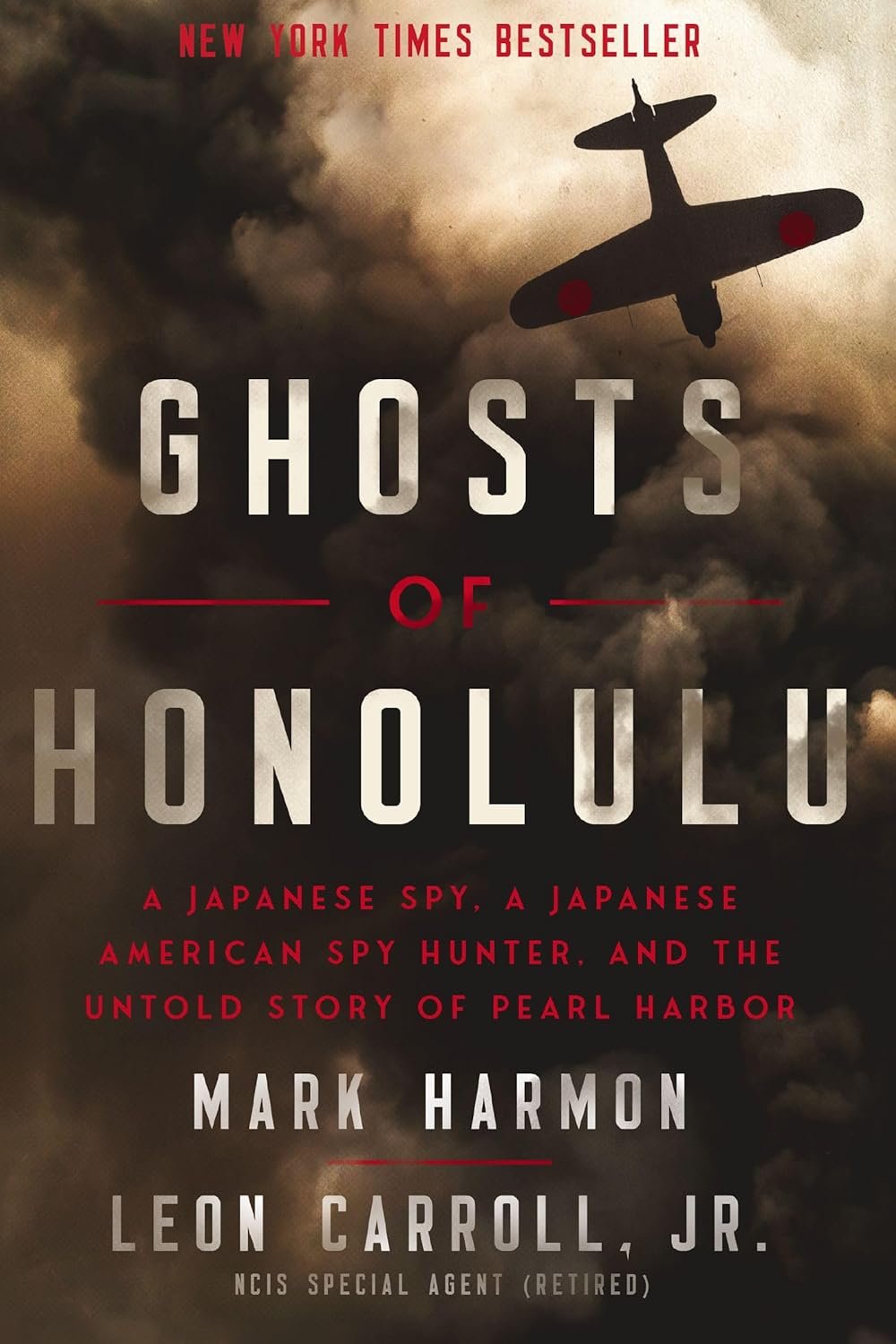
Ghosts of Honolulu: A Japanese Spy, A Japanese American Spy Hunter, and the Untold Story of Pearl Harbor
View on Amazon
Ghosts of Honolulu: The Hidden World of Espionage Before Pearl Harbor
World War II is often remembered through dramatic battles, political decisions, and the heroism of soldiers on the frontlines. Yet, beneath the headlines and history books lies another layer of tension—a clandestine world of spies, intelligence officers, and covert operations that shaped the course of the war before the first bombs fell. Ghosts of Honolulu, co-written by NCIS star Mark Harmon and former NCIS Special Agent Leon Carroll, uncovers one of these hidden narratives, revealing the dangerous and intricate game of espionage that played out in Hawaii leading up to the attack on Pearl Harbor.
This New York Times bestseller combines meticulous research with gripping storytelling to illuminate the dual perspectives of two men whose lives intersected amid a looming global conflict: Douglas Wada, a Japanese American officer working for U.S. naval intelligence, and Takeo Yoshikawa, a Japanese spy gathering intelligence for the Imperial Japanese Navy.
Hawaii, 1941: A Stage Set for Espionage
By 1941, tensions between the United States and Japan had escalated to the point of war. Hawaii, with its strategic naval base at Pearl Harbor, became the focal point of military planning, political maneuvering, and covert intelligence activity. Amid the idyllic islands and bustling ports, a hidden battlefield was emerging—one fought not with bullets or bombs, but with information, deception, and subtle manipulation.
In Ghosts of Honolulu, readers are introduced to the high-stakes environment of pre-war Hawaii, where spies and counterintelligence officers operated in plain sight, and residents often had no idea how close danger really was. The islands were a microcosm of global tensions: a mixture of military personnel, diplomats, and civilians caught in a game of shadow and secrecy.
Douglas Wada: The American Counterintelligence Officer
Douglas Wada was a Japanese American officer serving in U.S. naval intelligence, uniquely positioned to understand both his heritage and his country’s security concerns. His work required meticulous attention to detail, patience, and a readiness to confront danger at a moment’s notice. Wada’s assignments included posing undercover as a newspaper reporter, translating sensitive communications intercepted from the Japanese Consulate, and interrogating captured enemy personnel.
One of his most notable experiences involved questioning America’s first prisoner of war of World War II—a submarine officer discovered washed ashore in Hawaii. Wada’s fluency in Japanese and deep cultural understanding allowed him to navigate these situations with skill, but his position was precarious. As a Japanese American, he lived under the constant threat of suspicion from his own government, even as he risked his life to safeguard critical intelligence.
Through Wada’s eyes, readers gain a vivid sense of the immense challenges faced by American counterintelligence officers on the eve of Pearl Harbor. Every interaction carried weight; a single misstep could compromise operations or endanger lives. The book portrays Wada not only as a skilled operative but also as a man balancing loyalty, identity, and duty in a time of growing paranoia and war hysteria.
Takeo Yoshikawa: The Japanese Spy in Plain Sight
Opposite Wada is Takeo Yoshikawa, a Japanese operative sent to Hawaii under the guise of a junior diplomat at the Japanese Consulate. His mission: gather vital intelligence on the U.S. Pacific Fleet and relay it to Admiral Isoroku Yamamoto, one of Japan’s most influential military strategists.
Yoshikawa’s work required subtlety, patience, and cunning. Posing as a diplomat allowed him to move freely and access information that would have been otherwise unattainable. Every observation, every piece of data he collected, could potentially change the outcome of future military operations. The book details the methods he used to monitor fleet movements, communicate secretly, and avoid detection in a place where suspicion was growing daily.
Harmon and Carroll present Yoshikawa’s story with nuance, emphasizing the skill and discipline required to maintain a cover while operating in enemy territory. His life in Hawaii highlights the dangerous intersection of diplomacy and espionage—a delicate balance where exposure could have devastating consequences.
A Community Caught Between Two Worlds
Ghosts of Honolulu does more than follow spies and intelligence officers. It explores the lives of Hawaii’s residents during this tense period, including Douglas Wada’s own father, who faced prejudice and suspicion as anti-Japanese sentiment spread. Unlike the mass internments seen in California, Hawaii’s Japanese American population remained largely in place, but the social climate was charged with fear and mistrust.
The book portrays the psychological and social pressures faced by ordinary citizens, showing how war infiltrates everyday life. Neighborhoods, schools, and workplaces became spaces of caution and hidden scrutiny, where loyalties were questioned and simple acts of friendship or kindness could be misinterpreted.
The Shadowy Game of Intelligence
The core of the book lies in the cat-and-mouse dynamics between Wada and Yoshikawa. These dueling narratives bring readers into a world of coded messages, surveillance, and strategic deception. Each man must anticipate the other’s moves while managing the constant uncertainty of an evolving geopolitical landscape. The narrative emphasizes the tension of working in the shadows, where what appears ordinary may conceal critical secrets.
Adding further complexity is the presence of a mercenary Nazi, whose involvement underscores the international dimension of intelligence work in Hawaii. The islands become a chessboard, where every move carries the weight of potential global consequences.
The Morning That Changed Everything
On December 7, 1941, the carefully concealed operations of Wada, Yoshikawa, and others collided with history. The attack on Pearl Harbor shattered the illusion of safety in Hawaii and exposed the true stakes of the intelligence game. For Wada, Yoshikawa, and those caught in between, the morning brought bloodshed, revelation, and irrevocable change.
Ghosts of Honolulu does not simply recount the attack; it places it in the context of prior intelligence battles, decisions made in the shadows, and the painstaking work that both delayed and shaped the attack’s outcome. The book emphasizes that history is often determined not only by what happens in public but by countless unseen acts of vigilance, courage, and deception.
Historical Depth and Meticulous Research
Harmon and Carroll’s work stands out because it is based on long-buried historical documents and first-hand accounts. Their collaboration bridges the worlds of historical research and practical intelligence, providing readers with an authentic perspective on pre-war Hawaii.
The book is richly detailed, capturing the physical environment of 1940s Honolulu, the daily routines of intelligence officers, and the personal stakes of everyone involved. Readers gain a nuanced understanding of the delicate balance between civil liberties and national security, the complexity of ethnic identity in wartime, and the human consequences of espionage.
Why Ghosts of Honolulu Matters Today
In addition to recounting historical events, the book explores universal themes: courage under pressure, the ambiguity of loyalty, and the tension between appearance and reality. It challenges readers to consider how individuals navigate morality and duty in times of crisis and how ordinary people are affected by extraordinary events.
The story’s dual focus on Wada and Yoshikawa also emphasizes the humanity of both sides. While Yoshikawa’s actions were aligned with Japan’s wartime strategy, the book depicts his intelligence work as a disciplined, methodical profession rather than caricatured villainy. Similarly, Wada’s contributions highlight the often-overlooked sacrifices of Japanese Americans in national defense, revealing a complex, layered narrative that goes beyond simple notions of heroism or villainy.
Conclusion
Ghosts of Honolulu is a compelling historical narrative that brings to life the hidden world of naval intelligence in Hawaii before Pearl Harbor. Through the parallel stories of Douglas Wada and Takeo Yoshikawa, readers are transported into a high-stakes environment where every decision carries immense consequences.
Mark Harmon and Leon Carroll combine meticulous research, gripping storytelling, and historical insight to deliver a book that is as educational as it is thrilling. This is not merely a tale of war; it is a testament to the courage, ingenuity, and humanity of individuals operating in the shadows. For anyone interested in espionage, World War II history, or the untold stories behind pivotal moments, Ghosts of Honolulu offers a fascinating and unforgettable read.


Related Posts

FrSara Neck Fan, Bladeless Neck Fan,Upgraded 5200mAh,Long Endurance,Upgraded air volume,Easier to Use,360° Cooling,No Hair Twisting,Non-Slip Material,Rechargeable,3-Speed

BestOffice Computer Desk,Home Office Desk, Modern Simple Style for Home Office Study Writing (Black, 32 inch)